State of the Global Workplace in 2026.

In 2025, global employee engagement declined for a second year to its lowest level since 2020.
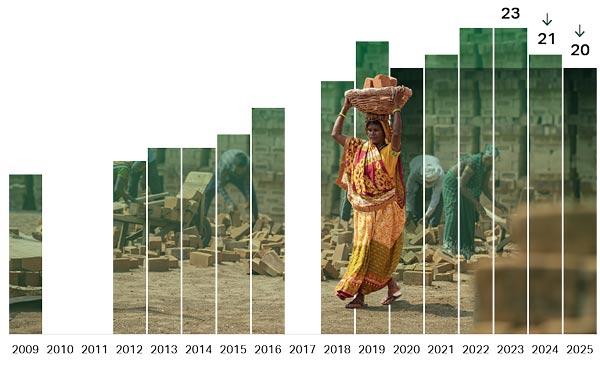
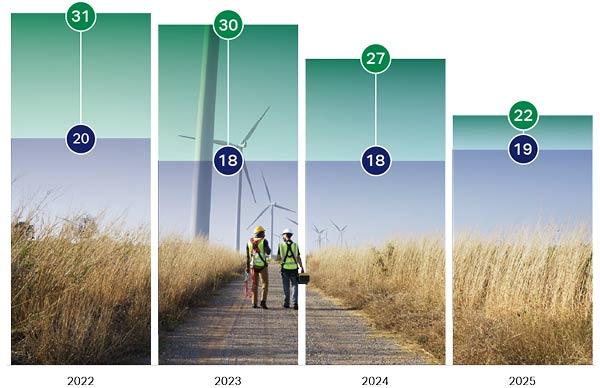
Lower engagement among managers accounts for most of the recent downturn in employee engagement.
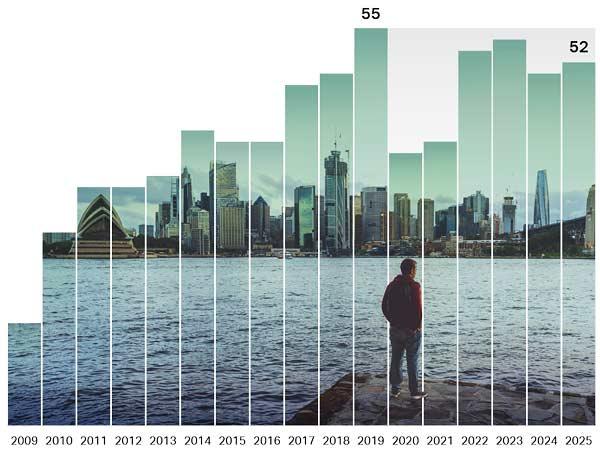
Global employee perceptions of the job market improved in 2025, though still below their 2019 peak.
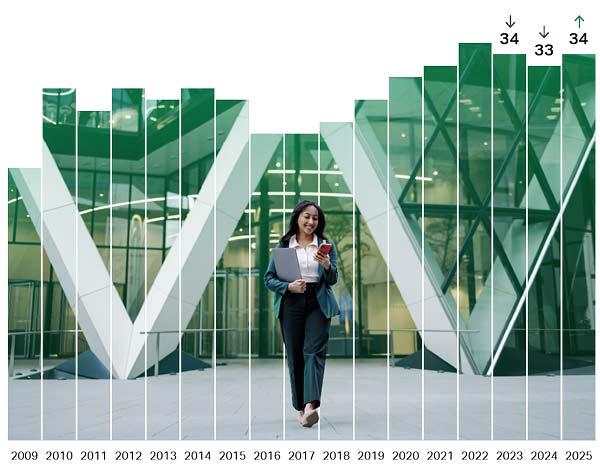
In 2025, global employee wellbeing improved for the first time in three years.
The Employee Engagement Slump Continues
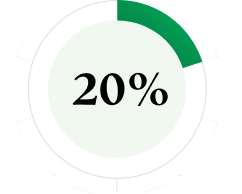
According to Gallup research, the world’s employee engagement has dropped to 20% from its peak in 2022 of 23%, with a margin of error of less than ±0.1 pct. pt.
Despite the recent downturn, employee engagement is eight percentage points higher than it was in Gallup’s first measurement in 2009 and five points higher than it was a decade ago. Each percentage point accounts for approximately 21 million employees working for organizations. For millions of workers, the workplace has improved.
That said, recent years are a cause for concern. This is the first time global engagement has dropped for two consecutive years. The largest drop was in South Asia (-5 points). No region of the world increased engagement in the past year.
Last year, low engagement cost the world economy approximately $10 trillion in lost productivity, or 9% of GDP.
Employee engagement measures the psychological attachment workers have to their work, their team and their employer. Gallup meta-analyses over the years have consistently shown a strong relationship between employee engagement and business-unit productivity, including profitability and sales.
While engagement occurs at the team level, employees who are not engaged or actively disengaged lead to less profitable organizations, which, in turn, translates into lower economic growth.
The Shrinking Perk of Being a Manager
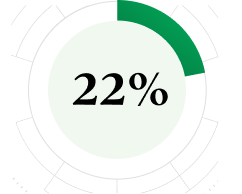
Since 2022, Gallup finds manager engagement has dropped by nine points.
Individual contributor engagement also declined but has had a slight rebound. According to the 2026 State of the Global Workplace report, the largest year-over-year drop in manager engagement occurred between 2024 and 2025, when it declined by five points from 27% to 22%. In short, managers used to enjoy an “engagement premium” at work, but they are increasingly only as engaged as those they lead.
South Asia’s decline in manager engagement suggests organizational flattening may be a factor.
In 2025, South Asia (primarily India) experienced an eight-point decline in manager engagement, the largest decline of any region. At the same time, the percentage of managers in South Asia also declined, suggesting that employers are cutting management roles.
Some evidence suggests that in 2025, India’s IT sector saw a substantial slowdown in hiring, along with cuts to mid-level and senior roles, possibly driven in part by AI adoption. With fewer managers in place, team sizes may grow. A recent Gallup study of U.S. managers and team size found that manager engagement declines with larger spans of control, though manager talent and training can offset this effect.
Declining manager engagement is by no means inevitable.
Organizations of all sizes can achieve high levels of manager engagement.
In 2025, Gallup found that within best-practice organizations, 79% of managers were engaged at work — nearly quadruple the global average.
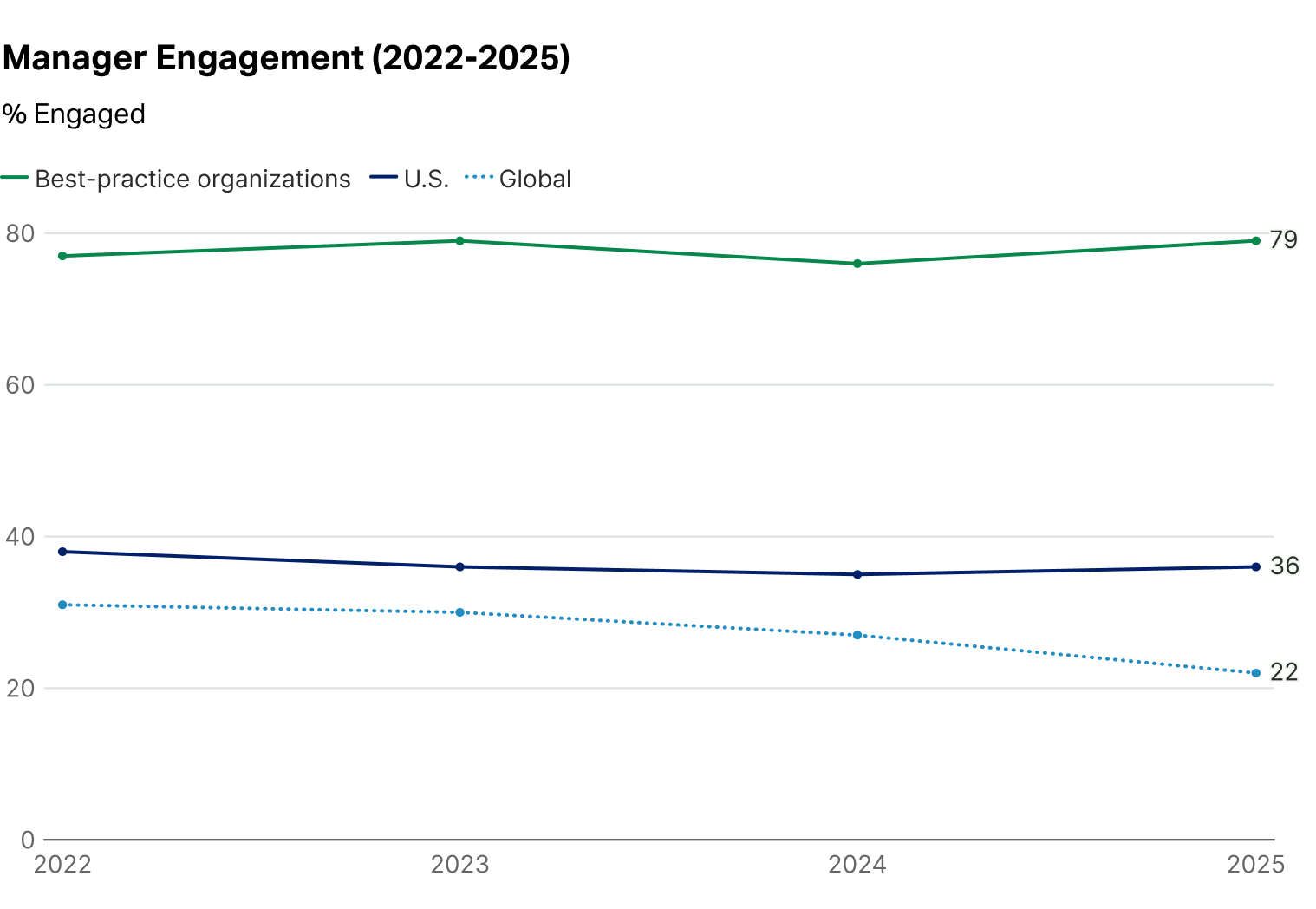
These world-class workplaces span all regions and industries, prioritizing employee engagement as part of their long-term business strategy.
The Future of Jobs
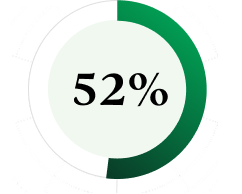
Global employee perceptions of the job market improved in 2025, according to Gallup, following a decline the previous year.
As the global economy recovered from the pandemic in 2022, so did job market optimism. In 2023, the percentage of employees who said it was a “good time” to find a job almost tied its 2019 record of 55%.
The last two years, however, have seen job market perceptions lower than at the start of the recovery in 2022. The 2026 State of the Global Workplace report finds that in 2025, job market perceptions improved by one percentage point from the previous year to 52%, with a margin of error of ±0.1 percentage point.
The 2025 increase in job market optimism came entirely from non-remote-capable, fully on-site workers (+2 points).
Job market optimism dropped for fully remote workers (-5 points) and remote-capable, fully on-site workers (-14), while optimism remained flat among hybrid workers. The drop in optimism among remote-capable workers could be due to possible declines in remote job opportunities caused by changes in employer policies or the automation of knowledge work.
In 2025, job market optimism fell sharply in the Australia/New Zealand (-12 points) and the United States/Canada (-10) regions.
Post-pandemic Australia/New Zealand has typically had the best job market in the world, based on employee perceptions. Last year, they fell to second place behind Southeast Asia.
The United States/Canada region, however, is now second-to-last in regional job market rankings. Since 2019, this region has fallen 23 points, from 70% to 47%.
U.S. business media reported on a “no hire, no fire” job climate for most of 2025; more recent revisions to official jobs numbers found that the U.S. added 181,000 jobs last year, compared with 1.5 million the year before. Gallup’s U.S. employee job market survey tracks official jobs data closely.
When employees feel they have a choice in their work, they are nearly 50% more likely to say it’s a good time to find a job.
In partnership with PERSOL and the Wellbeing for Planet Earth Foundation, Gallup has found that when employees feel they have a lot of choice in the work they can do, they are more optimistic about the job market. This holds across every region of the world. As technologies like AI reshape the world of work, upskilling will likely be an essential part of employee hope for the future.
Managing the Emotional Workplace
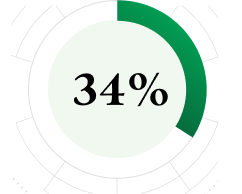
After a five-year run of consistent improvement in employee wellbeing (2018-2022), global thriving peaked in 2022 and then started to decline, according to Gallup.
In 2025, employee thriving increased by one point, from 33% to 34%. Half of the world regions saw a rise in thriving, with Latin America and the Caribbean (+2 points) and Europe (+2) experiencing the largest increases.
Gallup research finds the percentage of employees who report experiencing a lot of stress, anger or sadness the previous day remains above pre-pandemic levels.
Daily negative emotions among workers increased worldwide during the pandemic. Although they have declined from their peaks, negative emotions remain elevated compared to before 2020, suggesting either lasting psychological impacts or a new, more challenging status quo.
Wellbeing increases when employees see their work as intrinsically rewarding and good for others.
New analysis of Gallup data, collected in partnership with the Wellbeing and Planet Earth Foundation and PERSOL, shows that when employees enjoy their work, feel it improves others’ lives and believe they have choices in what they do, they report stronger wellbeing and higher workplace engagement.
- Gallup’s life evaluation measure combines how respondents feel about their current life and how they expect their life to be in five years (see How Gallup Measures the State of the Global Workplace).
Leaders have higher life evaluations but worse days than those they lead, according to Gallup data.
In psychology, wellbeing can be measured by examining the reflective self or the experiencing self. How people think about their lives does not always match how they experience them day to day.
When comparing leaders, managers, project managers and individual contributors, higher levels of leadership report higher levels of engagement and wellbeing. At the same time, compared with individual contributors, leaders are substantially more likely to report experiencing a lot of stress (+7 points), anger (+12), sadness (+11) and loneliness (+10) the previous day.
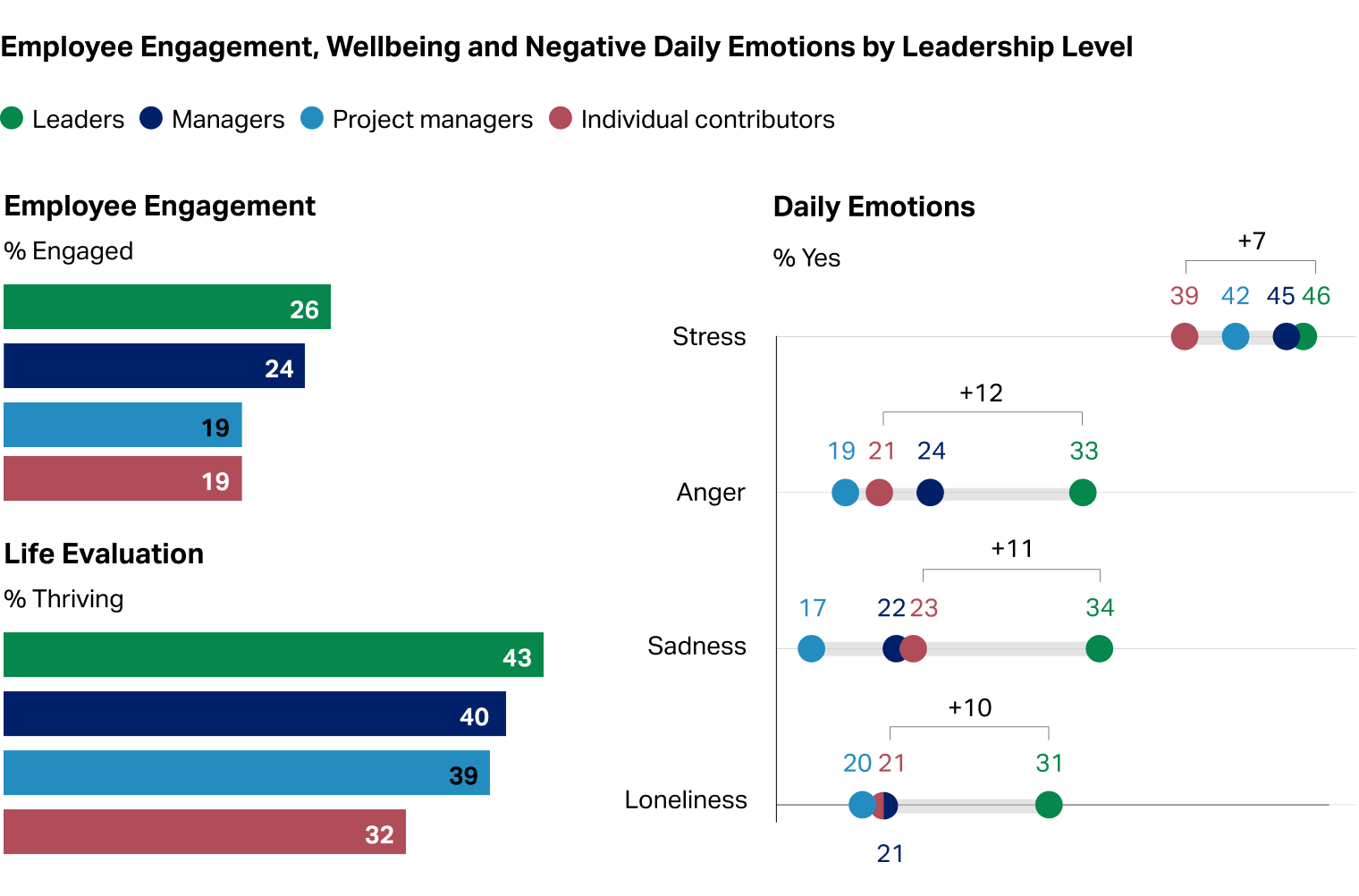
Leadership also offers little upside in terms of positive emotions: Leaders are less likely than individual contributors to say they smiled or laughed a lot the previous day and less likely than managers to report experiencing enjoyment. Although leadership can give individuals a greater sense of voice, agency and status, it can also mean greater social distance and the responsibility for making painful choices that affect many people’s lives.
AI Adoption and the Global Workplace
- The following section is compiled from analysis included throughout the State of the Global Workplace: 2026 Report. It is based on U.S. surveys, not Gallup World Poll data.
AI improves personal worker productivity, but macro-level benefits remain elusive.
Among U.S. workers in organizations that have implemented AI, 65% say that AI has had a “somewhat” or “extremely” positive impact on their individual productivity (7% say “somewhat” or “extremely” negative). At the same time, only 12% strongly agree that AI has transformed how work gets done in their organization.
Surveys of leaders reinforce the same disconnect between individual productivity gains and organizational outcomes that employees report. A recent NBER survey of executives in the U.S., U.K., Germany and Australia found that while AI use is widespread in corporations, 89% of leaders report no impact of AI on their company’s labor productivity in the past three years. However, they expect AI will boost productivity by 1.4% over the next three years.
One way of thinking about employee engagement is as a measure of readiness for change. AI is a major disruption; organizations with engaged employees tend to navigate disruptions more successfully. In the age of AI, productivity gains will depend in part on how effectively individual workers use these tools. Disengagement will erode those gains, and active disengagement could create serious security risks.
Managers play a critical role in meaningful AI adoption.
Based on Gallup’s Q1 2026 U.S. workforce survey, the top two drivers of frequent AI use within organizations are AI integration with existing systems and manager-led AI adoption.
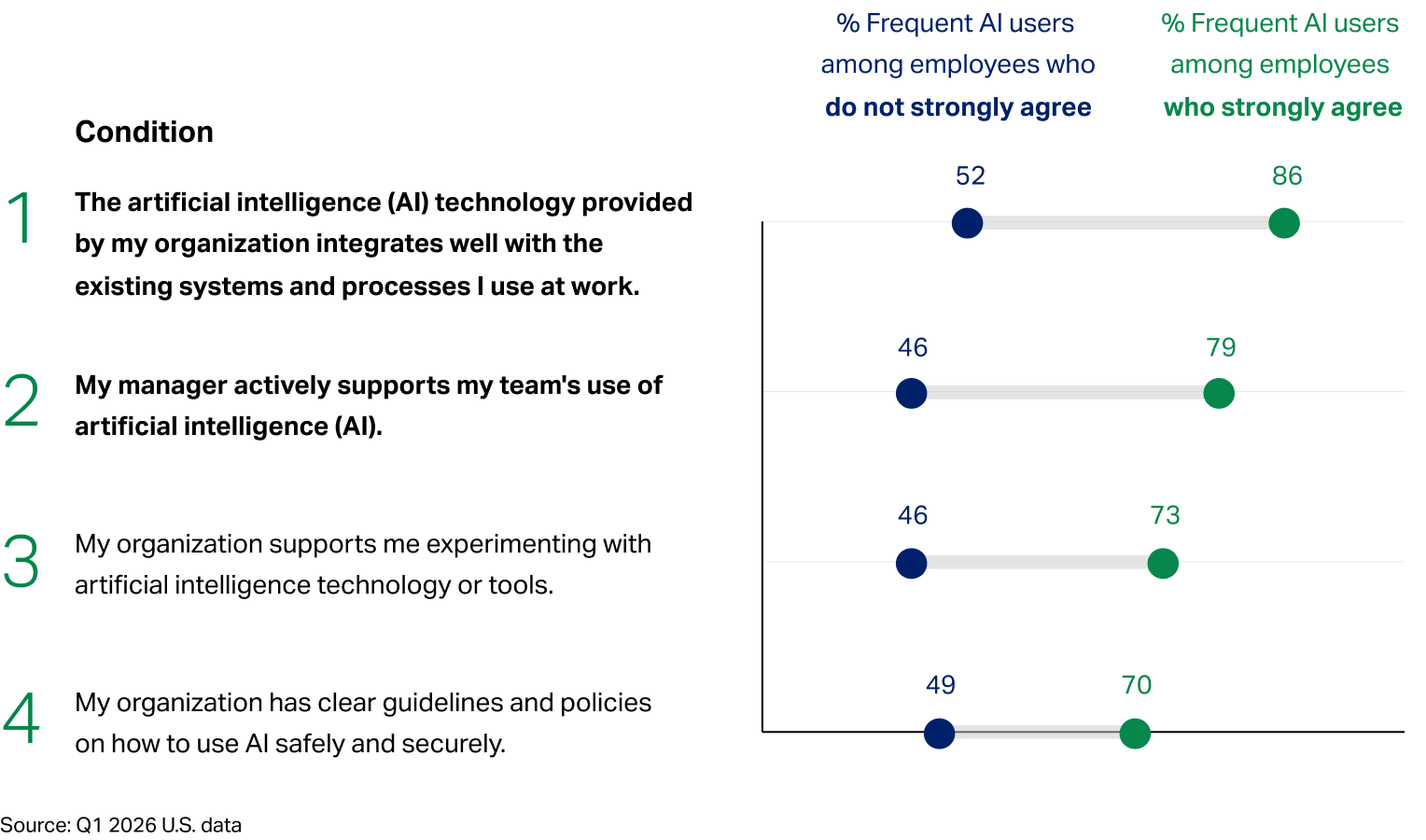
Gallup also finds that managers are key employees' perceptions of AI value. Within U.S. organizations that are investing in AI technology, employees who strongly agree that their manager actively supports their team’s use of AI are:
Despite these clear benefits, many employees report a lack of active support from their managers. Less than a third of U.S. employees in organizations that have begun implementing AI technologies strongly agree their manager actively supports their team’s use of the technology. A Gallup study in Germany found similarly low support: 21% of employees in organizations that use AI said their manager actively supports their team’s use of AI.
AI could boost global employee engagement by improving management practices at scale.
Effective people management is a skill. But few managers have natural management talent, and many have not received the training they need to successfully coach teams and individuals toward high performance. AI tools have the potential to provide real-time, personalized manager advice grounded in the best management science. Such capabilities could be a game-changer for the world’s workplace.

U.S. data show concerns about AI-related job losses are rising.
In Q1 of 2026, Gallup research found that 18% of U.S. employees said it was “very” or “somewhat” likely their job would be eliminated in the next five years due to technological innovations, such as automation or artificial intelligence. In organizations where AI has been implemented, that figure rises to 23%. In some industries, such as finance (32%), insurance (32%) and technology (31%), it is much higher. A separate Gallup survey in Germany found that 19% of German employees in organizations that use AI said it was very or somewhat likely that their job would be eliminated in five years due to automation or AI.
Large U.S. employers are more likely to reduce their workforce after implementing AI; smaller employers are more likely to expand their workforce.
In Q1 of 2026, Gallup asked U.S. employees if their employer was expanding or reducing the size of their workforce. Among employees in organizations where AI has been implemented, those who worked in large organizations (10,000+ employees) were more likely to say their employer was reducing their workforce (33%) than expanding (30%). However, those working in smaller organizations, for example, 5,000-10,000 employees, were more likely to say their employer was expanding (38%) vs. reducing (23%) their workforce.
Organizations that have begun implementing AI are more likely to change the size of their workforce — either by expanding or reducing headcount — than those that have not adopted AI. While AI is reconfiguring organizations, the effects on employment are not uniformly negative.
Engagement reduces the emotional burden of leading others and significantly boosts thriving.
Gallup finds that when managers (including leaders) are engaged, they report experiencing all negative emotions at lower rates than individual contributors. They are also 14 points more likely to be thriving in their overall life than the average leader.
When it comes to the AI revolution, recent Gallup research in the U.S. points to two factors that leaders can focus on to improve AI adoption and support the engagement and wellbeing of their workforces: taking steps to thoughtfully integrate AI into current systems and processes, and helping their managers to actively support their team’s use of AI.
Global Workplace Data
The State of the Global Workplace: 2026 Report includes a global summary of seven indicators of organizational resilience and performance:
- Employee Engagement
- Employee Life Evaluation
- Daily Emotions: Stress
- Daily Emotions: Anger
- Daily Emotions: Sadness
- Daily Emotions: Loneliness
- Employee Job Climate
- Visit State of the Global Workplace Report 2026 — Global Data for trends on each of these measures and comparisons across gender, age, job level and work location. Or, download the full report to access the data.


Comments
Post a Comment